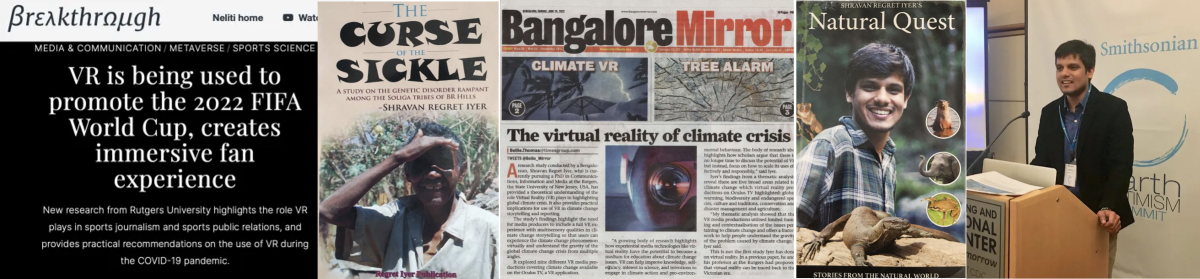

Dr. Shravan Regret Iyer giving a lightning talk at the Earth Optimism Summit, Ronald Regan Building (Washington, DC).
Teaching Statement:
My teaching philosophy is grounded in constructivist and active learning approaches, which I believe are essential for fostering an engaging and reflective educational environment.
Teaching has undoubtedly been one of the most important and exciting parts of my career at Rutgers. The most rewarding experience has been preparing and teaching at both the master’s and undergraduate levels, and it is clear from students’ evaluations that they find the courses I teach very valuable. In their evaluations, my students uniformly commented on the effective presentation of lecture materials, insightful responses to questions, their comfort in participating in class discussions, my accessibility as an instructor, and the overall quality of the learning environment.

As a Lecturer at the School of Communication and Information, Rutgers University-New Brunswick, Dr. Iyer has taught numerous master’s and undergraduate-level courses for the Department of Journalism and Media Studies, and the Department of Communication, including digital media ethics and exploring new media.
List of recent courses taught and teaching effectiveness:
- Digital Media Ethics – 594 (Spring-2023, Summer-2023, Fall-2023, and Spring-2024): A master’s level course, exploring the social and ethical implications of media technologies, offered as part of the Master’s in Communication and Media Program)
Teaching effectiveness: Spring 2023= 4.7/5; Summer 2023= 5/5; Fall 2023= 4.3/5; Spring 2024= 4.6/5.
University-wide Instructor Survey on organization of materials, effective responses to students, positive attitude toward assisting all students in understanding course material, grading, and encouraging student learning): Spring 2023= 4.9/5; Summer 2023= 4.9/5; Fall 2023= 4.5/5; Spring 2024= 5/5.
Quotes from the Rutgers University Student Instructional Rating Surveys:
Professor Iyer has been incredibly understanding and accommodating this semester. As a MCM student, I’ve truly enjoyed this course and the opportunity to learn something new every week. Every assignment has challenged my thinking and helped me grow as a student.- Master’s Student, Digital Media Ethics Course, Spring 2024.
He was awesome! All of his examples were real world examples and he throroughtly explained material.- Master’s Student, Digital Media Ethics Course, Spring 2024.
- Exploring New Media – 211 (Fall 2025 and Spring 2026): A 200-level undergraduate course where students examine digital media and evaluate their role, purpose, opportunities, consequences, and implications in society)
Teaching effectiveness: Spring 2026= 4.56/5; and Course Quality: 4.50/5
Quotes from the recent Rutgers University Student Instructional Rating Surveys:
I liked being able to relate my own life experiences to the topics and relate my experiences with my classmates. – Undergraduate Student, Exploring New Media Course, Spring 2026.
…made me more critical of both the media that I consume and also how I choose to interact with others about media consumption – Undergraduate Student, Exploring New Media Course, Spring 2026.

In the past, Dr. Iyer has also served as an assistant instructor, co-instructor, and grader for numerous master’s and undergraduate courses for both the Department of Journalism and Media Studies and the Department of Communication at the School of Communication and Information, Rutgers University.
- Media Studies Theory and Practice – 517 (Fall 2024): A master’s course that examines the nature and impact of the media of mass communication in society. Particular attention is paid to emerging media technology, including the Internet and other digital technologies.
- Media Field Production – 374 (Fall 2025 and Spring 2026): A 300-level undergraduate course that introduces students to the core principles and practices of Electronic Field Production (EFP), and focuses on the creative and technical aspects of producing media on location, from planning and directing to editing and equipment operation.
- Editing Multimedia – 373 (Fall 2025 and Spring 2026): A 300-level undergraduate course where students learn the essential concepts and workflows used to produce, manage, edit, and export audio and video content. The course takes a project-based approach, giving hands-on experience while preparing them for real opportunities in the media industry.

- Introduction to Communication & Information Processes (Emphasis on Health and Wellness) – 101 (Spring 2026): A 100-level undergraduate course that emphasizes how communication shapes health outcomes, patient experiences, and wellness behaviors. Students also critically analyze interpersonal communication and interactions in large-scale health campaigns.
- Consumer Media Culture – 274 (Spring 2026): A 400-level undergraduate course that provides a critical understanding of advertising’s role in society. Students examine the history of advertising, the commercial and social aspects of the messages conveyed by ads, and the advertising industry’s influence on social relations and journalism.
- Media, Marketing and Communication – 410 (Fall 2025): A 400-level undergraduate course for students to learn about various facets of marketing, in general, and social marketing, in particular. Learn how social and purposeful marketing can be used to improve the collegiate environment.
- Communication and Technology – 354 (Spring 2025): A 300- level undergraduate course that offers an overview of communication theory and research related to the use of a range of communication technologies in a variety of interpersonal, group, and societal contexts.
- Communication Research – 300 (Fall 2024): A 300-level undergraduate course that focuses on the uses of experimental, descriptive, historical-critical, and field-research approaches.
- Organizational Communication – 357 (Fall 2024): A 300-level undergraduate course that explores communication in organizations, communication networks, management and communication, decision making, goal setting, and process consultation in varying organizational settings.
- Intro to Media – 102 (Fall-2022, Spring-2023): A 100-level undergraduate course that explores the historical development of mass media institutions and the role of media in society with particular attention to news, government regulation, effects, economics, emerging technologies, and audience dynamics.

- Communication Theory – 200 (Spring-17, Fall-17): A 200- level undergraduate course that explores basic concepts, models, and theories examining the role of communication in human behavior.
- Introduction to Communication & Information Processes – 101 (Fall 2016 and Spring 2026): A 100-level undergraduate course that explores interpersonal, group, organizational, speech, mass, intercultural, and international communication; public relations and advertising.
- Persuasive Communication – 359 (Fall-16): A 300-level undergraduate course that explores the principles and techniques in persuasive communication, including credibility, audience analysis, assessment of effects, media selection, resistance to persuasion, and attitude change.

