Examining the role of VR first-person perspective in climate change communication particularly change knowledge, hope, fear, self-efficacy, and intended pro-climate action.
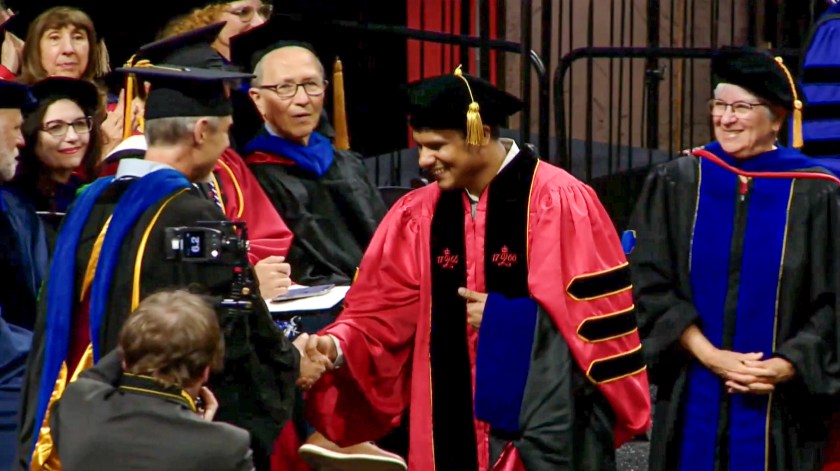
Shravan Regret Iyer was on Thursday, May 9th, 2024 awarded a Doctorate for Research on “Virtual Reality and Climate Change Communication” at Rutgers, a BIG 10 and Research 1 University in New Jersey, USA.
Dr. Shravan Regret Iyer’s research entitled “Understanding the Role of Virtual Reality First-Person Perspective in Climate Change Knowledge Outcomes and Pro-Climate Social Actions”, which was directed by Prof. John Pavlik, explores how VR can help people “see” and understand the impacts that their daily lifestyle choices have on the environment and what they can do to mitigate their carbon footprint. Particularly, his research examines whether VR first-person perspective in climate change communication facilitates climate change knowledge, hope, fear, self-efficacy, and intended climate action compared to VR non-first-person perspective climate change communication.
Shravan Regret Iyer said, “A growing body of research suggests that experiential media that offers the user a multisensory engagement that includes haptics or touch, gesture, gaze response, auditory interaction, and immersion, including 360° visual and auditory envelopment, could transform how people engage with content production. My research further explores this phenomenon and attempts to understand, using a between-subjects experiment, the effects of VR first-person perspective on climate change knowledge and people’s willingness to take action.”
His research also involves a longitudinal survey conducted one month after VR exposure to offer insights on whether the participants retained knowledge about climate change and actually took pro-climate social actions after experiencing VR content production.
Findings from Dr. Iyer’s research will help understand whether allowing people to embody their virtual avatar through VR first-person perspective while taking climate-friendly actions might empower participants and make them more confident (i.e., efficacious) in their ability to take action in the real world to reduce the impact of climate change. His work has the potential to highlight how VR can be used as a tool for increasing climate change knowledge and pro-climate action.
“I believe that the findings from my research can guide science communicators in the implementation of VR first-person perspective climate change projects at public schools, public libraries, or community centers to allow people of any age, race, gender, ability, or social class to transcend these categories and experience climate change realities in ways that might engender empathy and solidarity,” he added.
Further research, he added, could focus on a continued exploration in this area of research, particularly on the uses of experiential media for science communication, which would extend the understanding of the role of VR in climate change storytelling and pro-climate action.

Shravan Regret Iyer is an active researcher in the field of VR and climate change and continues to participate in international collaborative projects on experiential media. He has presented findings from his past research at national and international conferences held in Asia, Europe, and North America. In the past, he has also won the “New Directions for Climate Communication Research Fellowship” Honorable Mention awarded by the International Association for Media and Communication Research (IAMCR) and the International Environmental Communication Association for his work exploring the uses and effects of immersive media technologies for climate change communication.
For more about Dr. Shravan Regret Iyer’s work visit: https://shravanregretiyer.com/2020/07/07/research/




 Dr. SHRAVAN REGRET IYER