Examining the role of VR first-person perspective in climate change communication particularly change knowledge, hope, fear, self-efficacy, and intended pro-climate action.
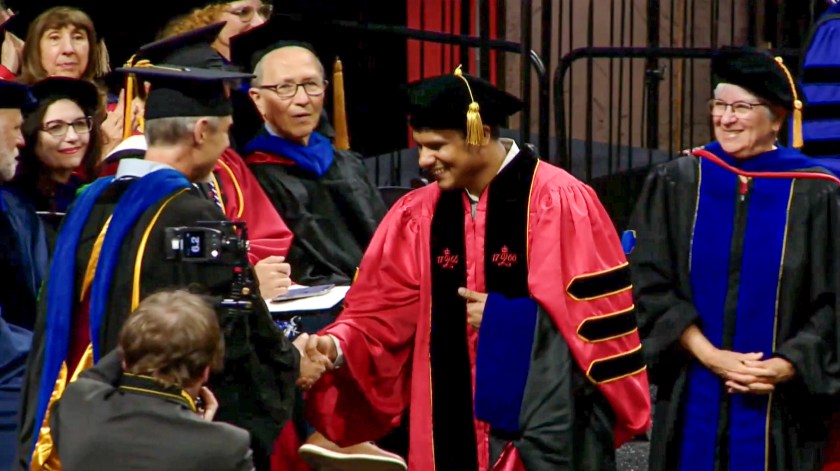
Shravan Regret Iyer was on Thursday, May 9th, 2024 awarded a Doctorate for Research on “Virtual Reality and Climate Change Communication” at Rutgers, a BIG 10 and Research 1 University in New Jersey, USA.
Dr. Shravan Regret Iyer’s research entitled “Understanding the Role of Virtual Reality First-Person Perspective in Climate Change Knowledge Outcomes and Pro-Climate Social Actions”, which was directed by Prof. John Pavlik, explores how VR can help people “see” and understand the impacts that their daily lifestyle choices have on the environment and what they can do to mitigate their carbon footprint. Particularly, his research examines whether VR first-person perspective in climate change communication facilitates climate change knowledge, hope, fear, self-efficacy, and intended climate action compared to VR non-first-person perspective climate change communication.
Shravan Regret Iyer said, “A growing body of research suggests that experiential media that offers the user a multisensory engagement that includes haptics or touch, gesture, gaze response, auditory interaction, and immersion, including 360° visual and auditory envelopment, could transform how people engage with content production. My research further explores this phenomenon and attempts to understand, using a between-subjects experiment, the effects of VR first-person perspective on climate change knowledge and people’s willingness to take action.”
His research also involves a longitudinal survey conducted one month after VR exposure to offer insights on whether the participants retained knowledge about climate change and actually took pro-climate social actions after experiencing VR content production.
Findings from Dr. Iyer’s research will help understand whether allowing people to embody their virtual avatar through VR first-person perspective while taking climate-friendly actions might empower participants and make them more confident (i.e., efficacious) in their ability to take action in the real world to reduce the impact of climate change. His work has the potential to highlight how VR can be used as a tool for increasing climate change knowledge and pro-climate action.
“I believe that the findings from my research can guide science communicators in the implementation of VR first-person perspective climate change projects at public schools, public libraries, or community centers to allow people of any age, race, gender, ability, or social class to transcend these categories and experience climate change realities in ways that might engender empathy and solidarity,” he added.
Further research, he added, could focus on a continued exploration in this area of research, particularly on the uses of experiential media for science communication, which would extend the understanding of the role of VR in climate change storytelling and pro-climate action.
Shravan Regret Iyer is an active researcher in the field of VR and climate change and continues to participate in international collaborative projects on experiential media. He has presented findings from his past research at national and international conferences held in Asia, Europe, and North America. In the past, he has also won the “New Directions for Climate Communication Research Fellowship” Honorable Mention awarded by the International Association for Media and Communication Research (IAMCR) and the International Environmental Communication Association for his work exploring the uses and effects of immersive media technologies for climate change communication.
On Wednesday August 3, 2022 at the Digital Media Environments session, doctoral student Shravan Regret Iyer is presenting, “Virtual reality and Climate Change: Understanding How the United Nations VR Content Productions Uses Experiential Media in Climate Change Storytelling.”
#IAMCR is pleased to announce that the 2022 Climate Communication Award will be awarded to Gabi Mocatta & Chloe Lucas for their project: "Curious Climate Interactive", with an Honourable mention to Shravan Regret Iyer. https://t.co/qIL3OkWhWc
The dancing female deities known as ‘apsaras‘ (in Sanskrit, meaning the female spirit of the clouds and waters in Hindu and Buddhist culture) were the first beings to emerge from the sea of creation.
In this visual, a dancer in a traditional dress is seen performing ‘apsara dance‘ (where gestures are codified to narrate classical stories), and an illustration of the entrance gate of Angkor Thom and the statues depicting Samudra Manthana i.e., churning of the ocean of milk can be seen in the background.
Join me in this virtual journey “This is Cambodia – All New Visual Series 2021”
Examining the role of VR first-person perspective in climate change communication particularly change knowledge, hope, fear, self-efficacy, and intended pro-climate action.
Click on the above image or visit this link for the full story
How to cite this paper: Regret Iyer, S. (2023). Looking for Climate in the Metaverse: A qualitative study. Many Voices, One Planet: Accounting for the Past and Narrating Sustainable Futures. The 17th Conference on Communication and Environment (COCE) in Harrisonburg,Virginia, June 5-9, 2023. The International Environmental Communication Association (IECA). https://event.fourwaves.com/coce2023/abstracts/1af10459-4545-40bf-81e5-39da631988e0
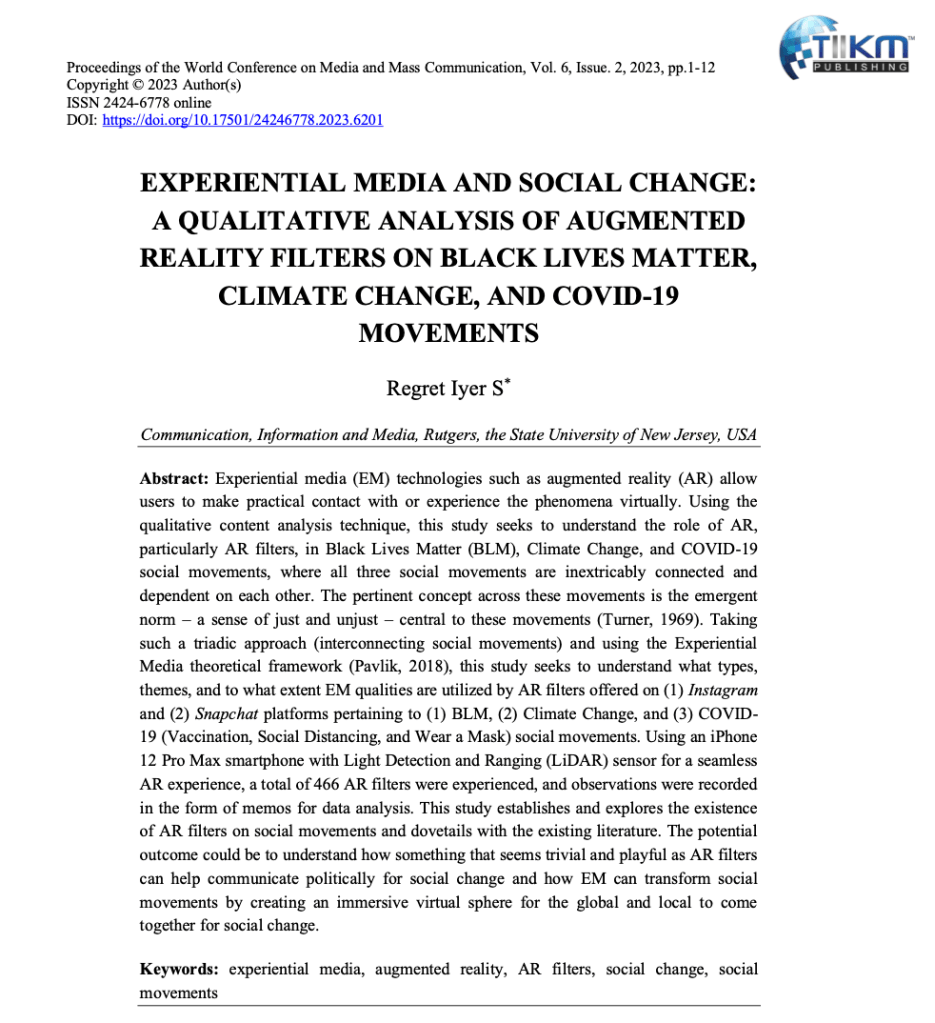
Experiential Media and Social Change: A Qualitative Analysis of Augmented Reality Filters on Black Lives Matter, Climate Change, and Covid-19 Movements
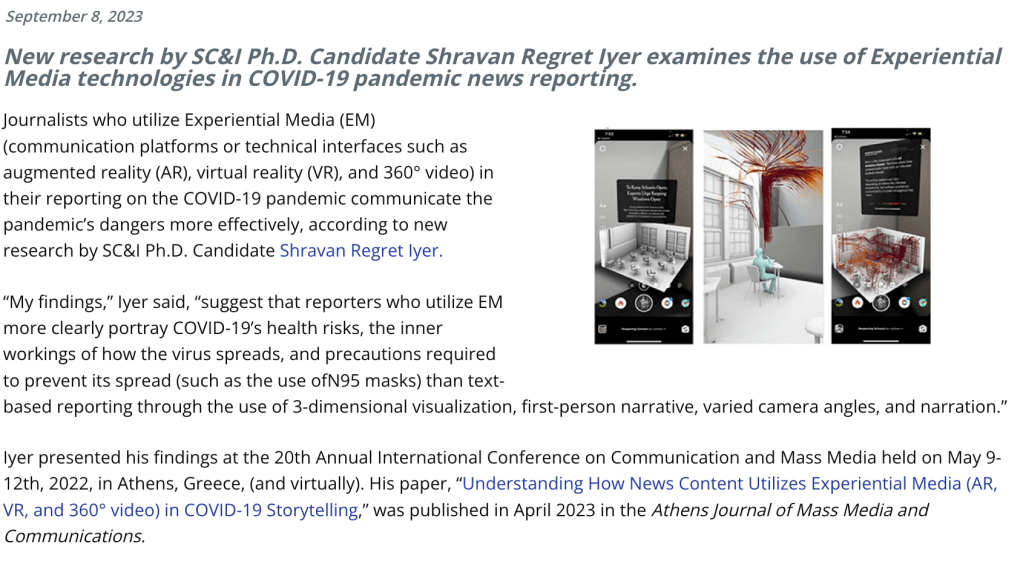
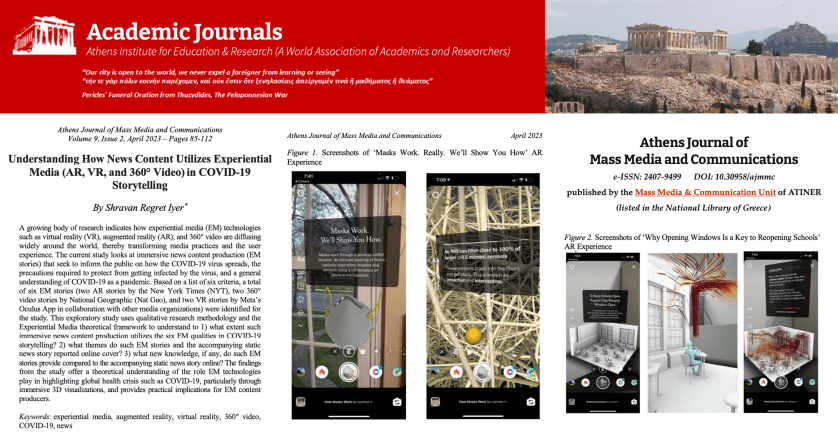
How to cite this paper: Regret Iyer, S. (2023). Understanding How News Content Utilizes Experiential Media (AR, VR, and 360° Video) in COVID-19 Storytelling, Athens Journal of Mass Media and Communications Volume 9, Issue 2. pp 85-112, DOI:10.30958/ajmmc.9-2-2. https://www.athensjournals.gr/media/2023-9-2-2-Iyer.pdf
For the full news article, click on the above image orhere
Assessing Virtual Reality Media Productions: Findings from a Qualitative Analysis of Immersive Experiences in Climate Change as Offered via Oculus TV
How to cite this paper: Regret Iyer, S. (2022). Assessing virtual reality media productions: Findings from a qualitative analysis of immersive experiences in climate change as offered via Oculus TV. Journal Communication Spectrum: Capturing New Perspectives in Communication12(2), 77-95. DOI: 10.36782/jcs.v12i2.2284
Click on the above image or visit this link for the full story
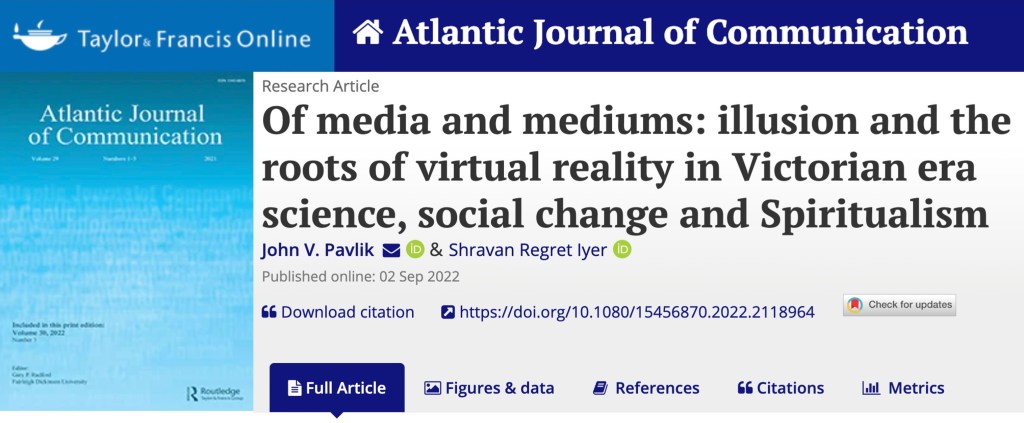
Of media and mediums: illusion and the roots of virtual reality in Victorian era science, social change and Spiritualism
How to cite this paper: John V. Pavlik & Shravan Regret Iyer (2022): Of media and mediums: illusion and the roots of virtual reality in Victorian era science, social change and Spiritualism, Atlantic Journal of Communication, DOI: 10.1080/15456870.2022.2118964
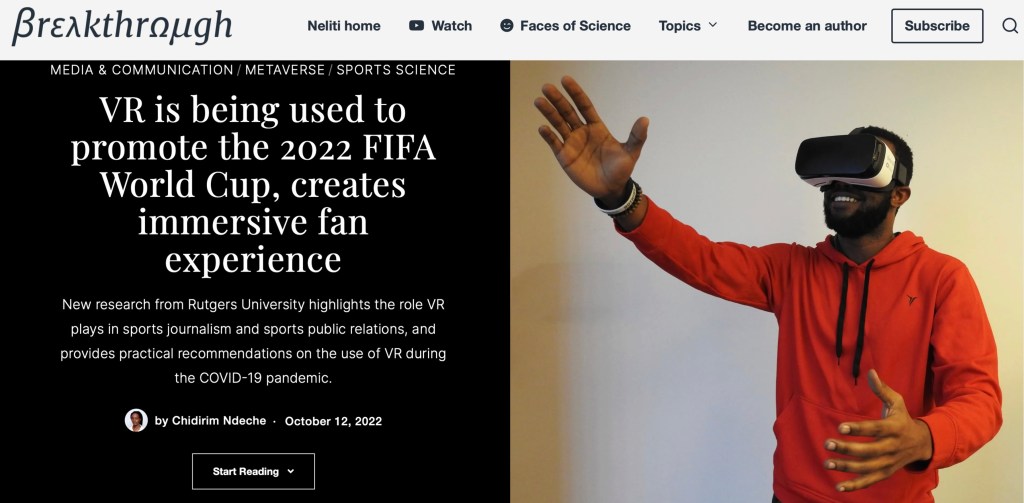
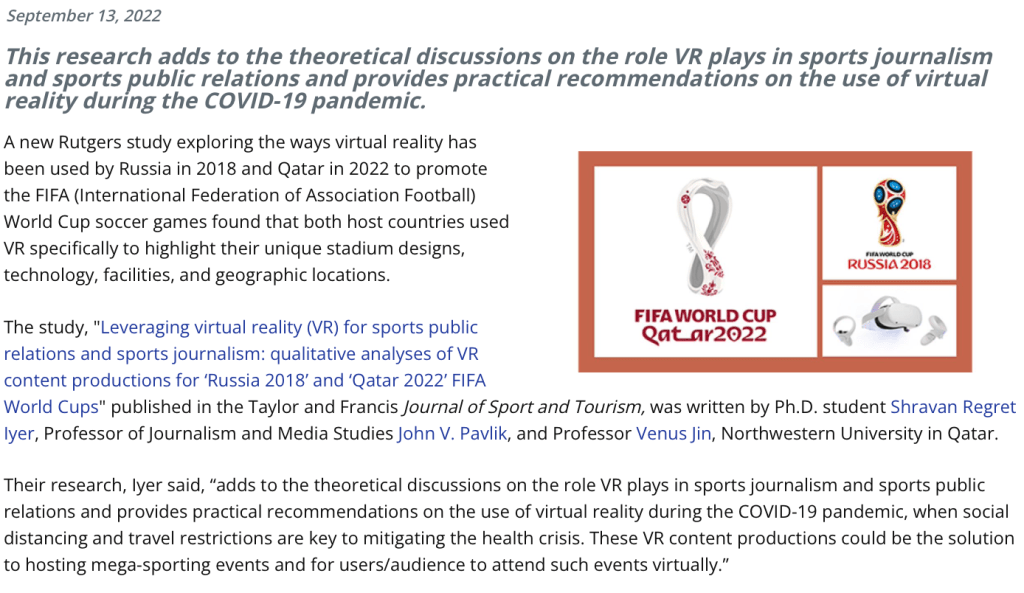
How to cite this paper: Shravan Regret Iyer, John Pavlik & S. Venus Jin (2022) Leveraging virtual reality (VR) for sports public relations and sports journalism: qualitative analyses of VR content productions for ‘Russia 2018’ and ‘Qatar 2022’ FIFA World Cups, Journal of Sport & Tourism, DOI: 10.1080/14775085.2022.2097942
Shravan Regret Iyer’s Research Proposal “Experiential Media and Climate Change” Awarded an Honorable Mention by IAMCR and IECA
Click on the above image or visit this link for the full story
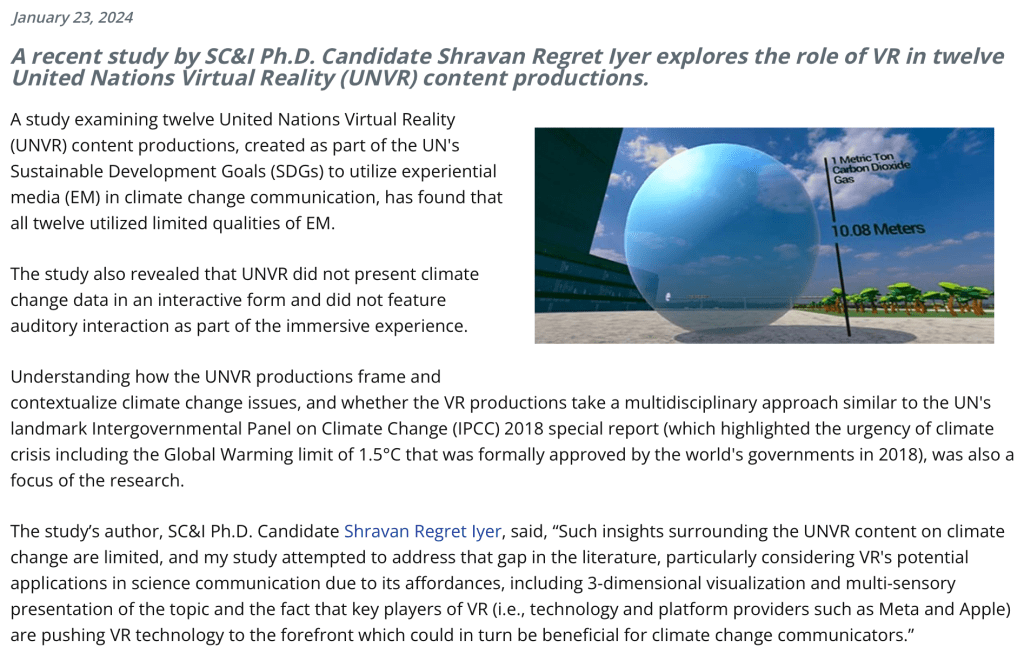
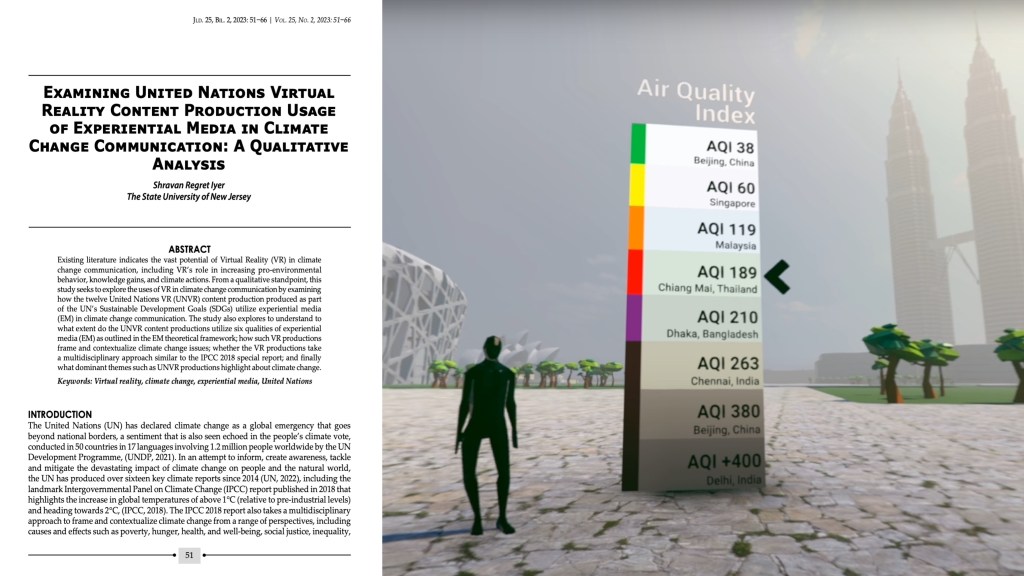
Virtual reality and Climate Change: Understanding How the United Nations VR Content Productions Uses Experiential Media in Climate Change Storytelling
Click on the above image or visit this link for the full story
Click on the above image or visit this link for the full story
How to cite this paper: Regret Iyer, S. (2022). Virtual Reality and Climate Change: A Qualitative Analysis of VR Media Productions on Oculus TV Using VR Head-Mounted Display. The International Association for Media and Communication Research (IAMCR) Beijing 2022 July 11-15, 2022 Beijing, China (Accepted).
Click on the above image or visit this link for the full story
How to cite this paper: Regret Iyer, S. (2022). Virtual Reality and Climate Change: A Qualitative Analysis of VR Media Productions on Oculus TV Using VR Head-Mounted Display. The International Association for Media and Communication Research (IAMCR) Beijing 2022 July 11-15, 2022 Beijing, China (Accepted).
Click on the above image or visit this link for the full journal article
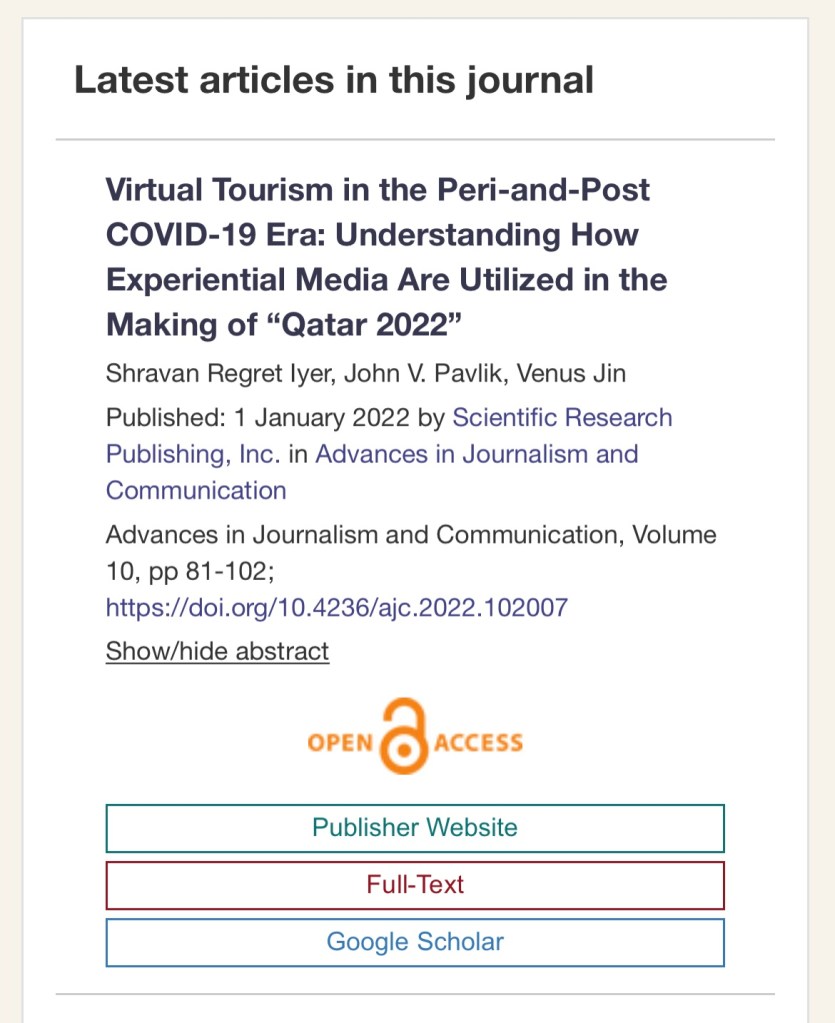
How to cite this paper: Regret Iyer, S., Pavlik, J. V., & Jin, V. (2022). Virtual Tourism in the Peri-and-Post COVID-19 Era: Understanding How Experiential Media Are Utilized in the Making of “Qatar 2022”. Advances in Journalism and Communication, 10, 81-102. https://doi.org/10.4236/ajc.2022.102007
Experiential Media and Social Change: A Qualitative Analysis of Augmented Reality Filters on Black Lives Matter, Climate Change, and COVID-19 (Vaccination, Social Distancing, And Wear a Mask) Movements
How to cite:Regret Iyer, S. (2022). Experiential Media and Social Change: A Qualitative Analysis of Augmented Reality Filters on Black Lives Matter, Climate Change, and COVID-19 (Vaccination, Social Distancing, and Wear a Mask) Movements. 7th World Conference on Media and Mass Communication (MEDCOM 2022) May 5-7, 2022 Virtual. ISBN 978-624-5746-17-0
Link to the MEDCOM 2022 conference book of abstract
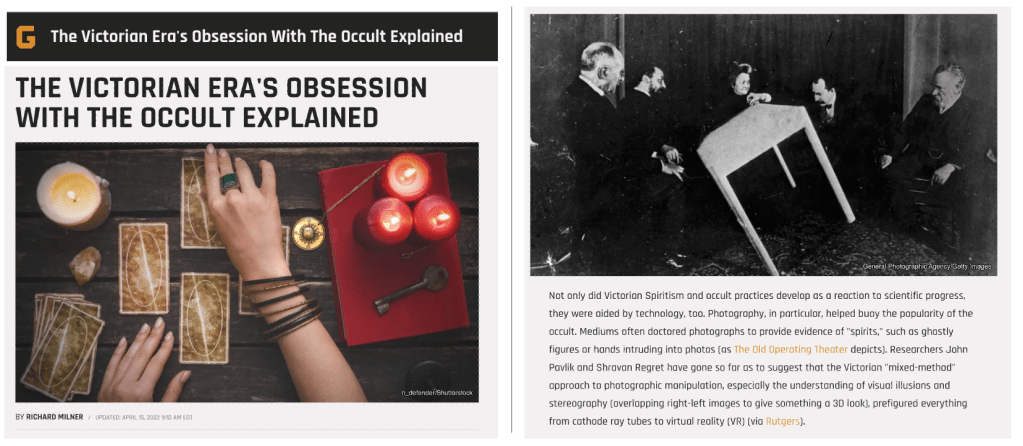
Not only did Victorian Spiritism and occult practices develop as a reaction to scientific progress, they were aided by technology, too. Photography, in particular, helped buoy the popularity of the occult. Mediums often doctored photographs to provide evidence of “spirits,” such as ghostly figures or hands intruding into photos (as The Old Operating Theater depicts). Researchers John Pavlik and Shravan Regret Iyer have gone so far as to suggest that the Victorian “mixed-method” approach to photographic manipulation, especially the understanding of visual illusions and stereography (overlapping right-left images to give something a 3D look), prefigured everything from cathode ray tubes to virtual reality (VR) (via Rutgers).
Click on the above image or visit this link for the conference book of abstracts.
How to cite: Regret Iyer, S. (2022). Understanding How News Content Utilizes Experiential Media in COVID-19 Storytelling: Findings from a Content Analysis. 20th Annual International Conference on Communication and Mass Media 9-12, May 2022, Athens, Greece. ISBN: 978-960-598-472-4
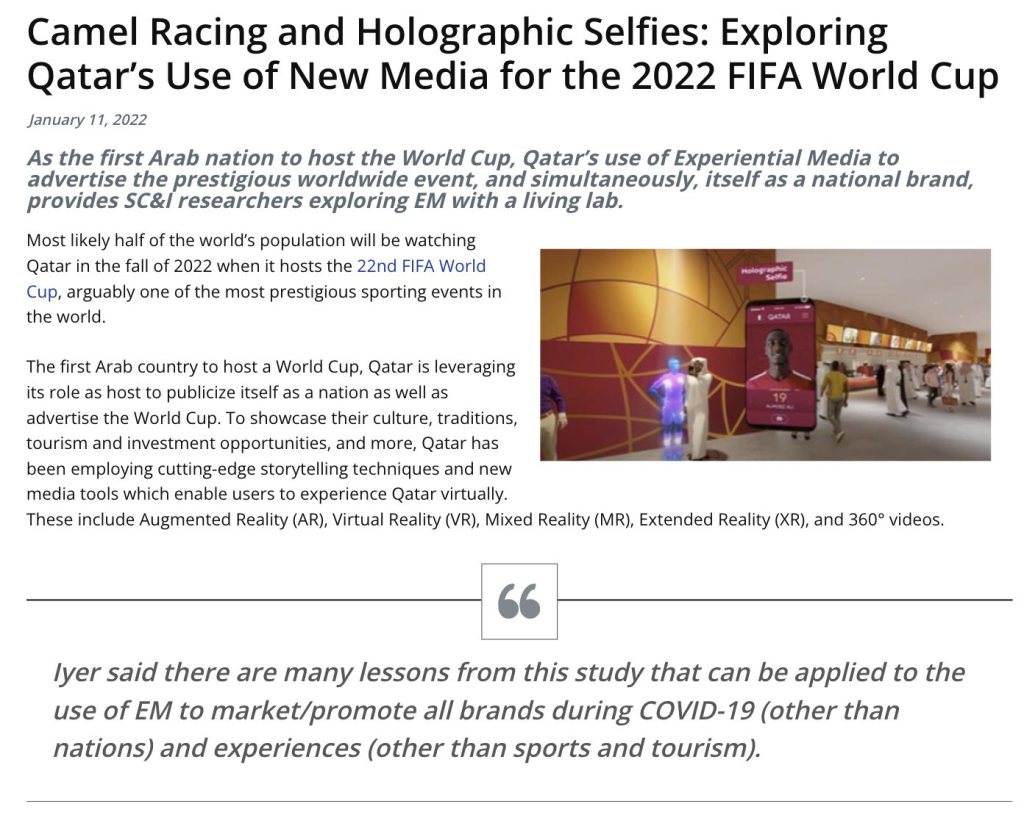
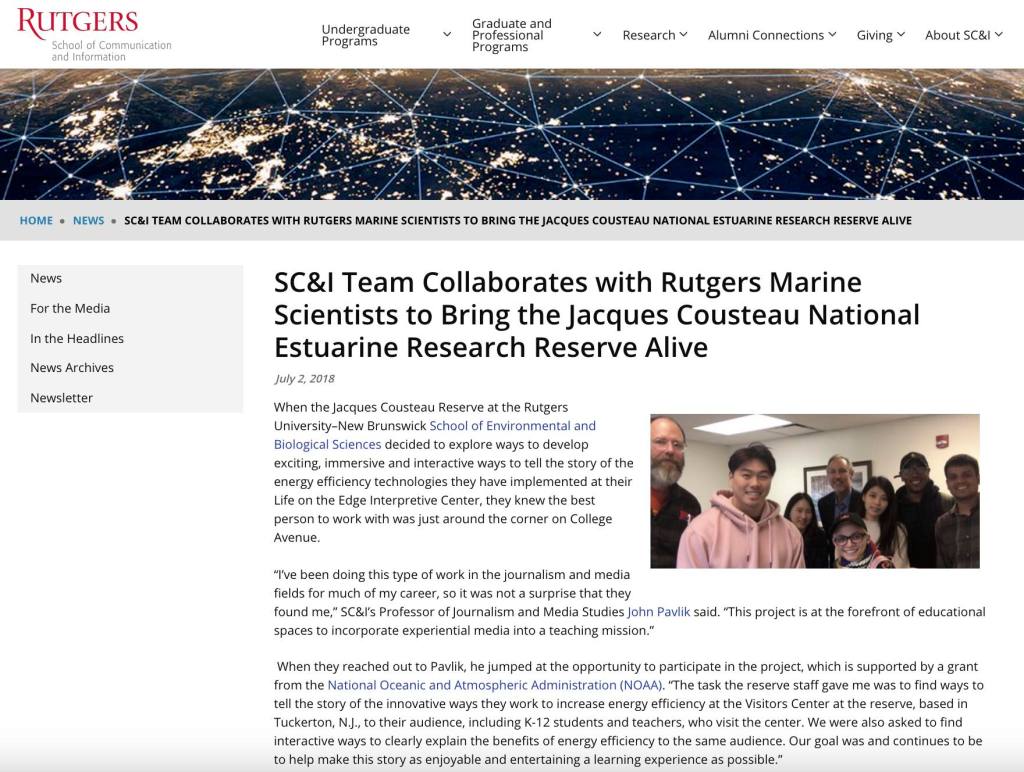
To explore the effectiveness of Qatar’s use of these innovative tools (collectively coined “Experiential Media” by SC&I Professor John V. Pavlik), in their storytelling and brand building, Ph.D. student Shravan Regret Iyer, Pavlik, and Professor Venus Jin of Northwestern University in Qatar have conducted new research that suggests Qatar could more effectively use EM to reach their goals.
How to cite: Iyer, S. R., Pavlik, J. V., Jin, V., Bergida, G., Striker, S., & Gengler., J. (2021). Understanding How Experiential Media are Utilized in the Making of ‘Qatar 2022’. 6th World Research Summit for Tourism and Hospitality 14-15 December 2021, Orlando, Florida.
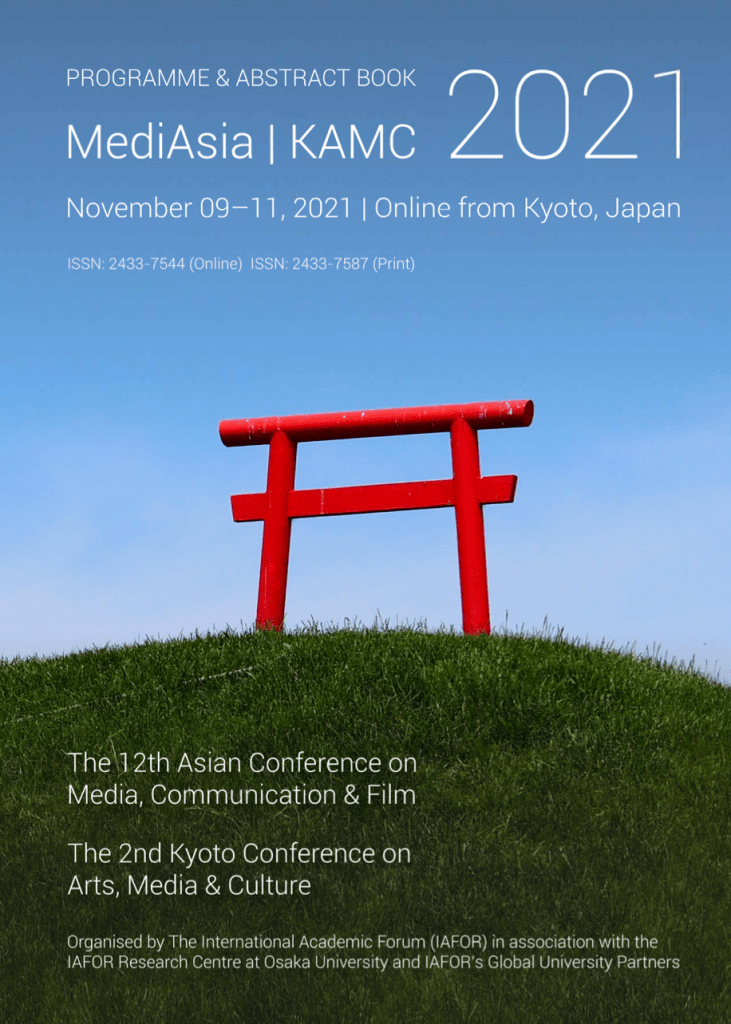
How to cite: Regret Iyer, S., Pavlik, J. V., Jin, V., Bergida, G., Striker, S., & Gengler., J. (2021). Understanding How Experiential Media Are Utilized in the Making of ‘Russia 2018’ and the Upcoming ‘Qatar 2022’ FIFA World Cup. 12th Asian Conference on Media, Communication & Film (MediAsia) 9-12 November 2021, Kyoto, Japan. ISSN: 2433-7544. (Online) ISSN: 2433-7587 (Print). https://iafor.org/archives/conference-programmes/mediasia/mediasia-programme-2021.pdf
Pavlik and Iyer presented their findings in the paper “Of Media and Mediums: Illusion and the Roots of Virtual Reality in Victorian Era Science, Social Change and Spiritualism,” at the 2021 New York State Communication Association Conference.
How to cite: Pavlik, J. V., & Regret Iyer, S. (2021). Of Media and Mediums: Illusion and the Roots of Virtual Reality in Victorian-era Science, Social Change and Spiritualism. New York State Communication Association 79th Annual Conference 15-17 October 2021, New York.
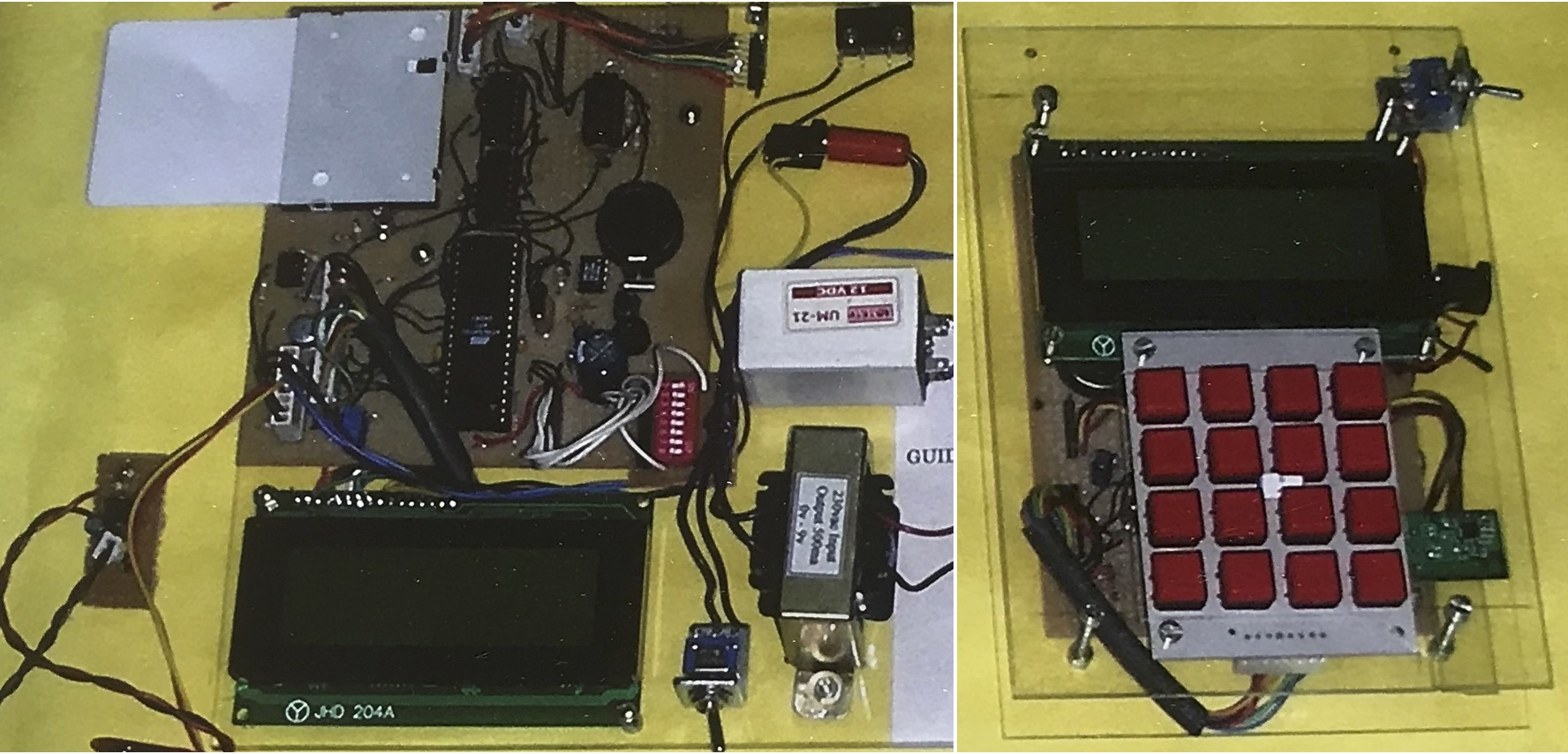
Co-developed a tamper proof ‘Smart Meter’ for power reading. The handheld device with a microcontroller, RF transceiver and LCD can be operated from a distance of 100 meters and provide error free reading.






















 Dr. SHRAVAN REGRET IYER